

Somewhere around age eleven, “how was your day” stopped working on my kid. It’s probably happened to you too—you ask, they answer “fine,” and that’s the whole conversation. Not because they’re hiding something. The question just doesn’t leave them anywhere to go.
It’s easy to take that personally. It’s not personal—it’s structural. “How was your day” is what’s called a closed question: one with a natural, complete, one-word answer already built into it. “Fine” isn’t a dodge. It’s the correct answer to the question you actually asked.
This is the piece most deeper connection advice skips. It tells you to ask more, to ask better, to try harder—without ever explaining why the question you’re already asking keeps landing flat. Once you see the mechanism, it’s a lot easier to fix. (For the bigger picture on why this matters, see our post on how to have deeper conversations with the people you already love—this one goes deep on the “how was your day” problem specifically.)
The Problem Isn’t the Person. It’s the Shape of the Question.
Closed questions ask for a report. Open questions ask for a story. “How was your day?” asks someone to summarize eight hours into a single word. “What was the most annoying part of your day?” asks them to pick a moment and actually tell you about it.
The difference isn’t politeness or tone. It’s structural. A closed question can be fully answered in one word, so most people will—not out of resistance, but because that’s what the question invited. An open question can’t be answered in one word, so it pulls a story out almost by accident.
There’s a second problem hiding underneath the first: “How was your day?” also asks for a summary judgment. Most days aren’t a single thing—they’re twelve small things, some good, some annoying, some forgettable. Asking someone to compress all of that into “good” or “fine” is asking them to do a lot of editorial work before they’ve even opened their mouth. No wonder the easiest move is to just say “fine” and be done with it.
What to Ask Instead
The fix isn’t a longer question. It’s a more specific one. A few swaps that consistently get further than the original:
-
Instead of “How was your day?” try “What’s one thing that happened today that you didn’t expect?”
-
Instead of “How was school?” try “Who did you sit with at lunch, and what did you talk about?”
-
Instead of “Did you have a good day?” try “What was the best five minutes of your day? What was the worst?”
-
Instead of “How was work?” try “What’s something you wish had gone differently today?”
Notice the pattern: each one asks for a moment, not a summary. Moments are easy to describe. Summaries are hard to produce on the spot, especially at the end of a long day when nobody has much bandwidth left.
Why This Still Feels Hard, Even With Better Questions
Here’s the part that trips people up: even with a better question, the first few tries can still fall flat. That’s not a sign the question failed—it’s a sign the moment needs a little more scaffolding than a single well-worded sentence.
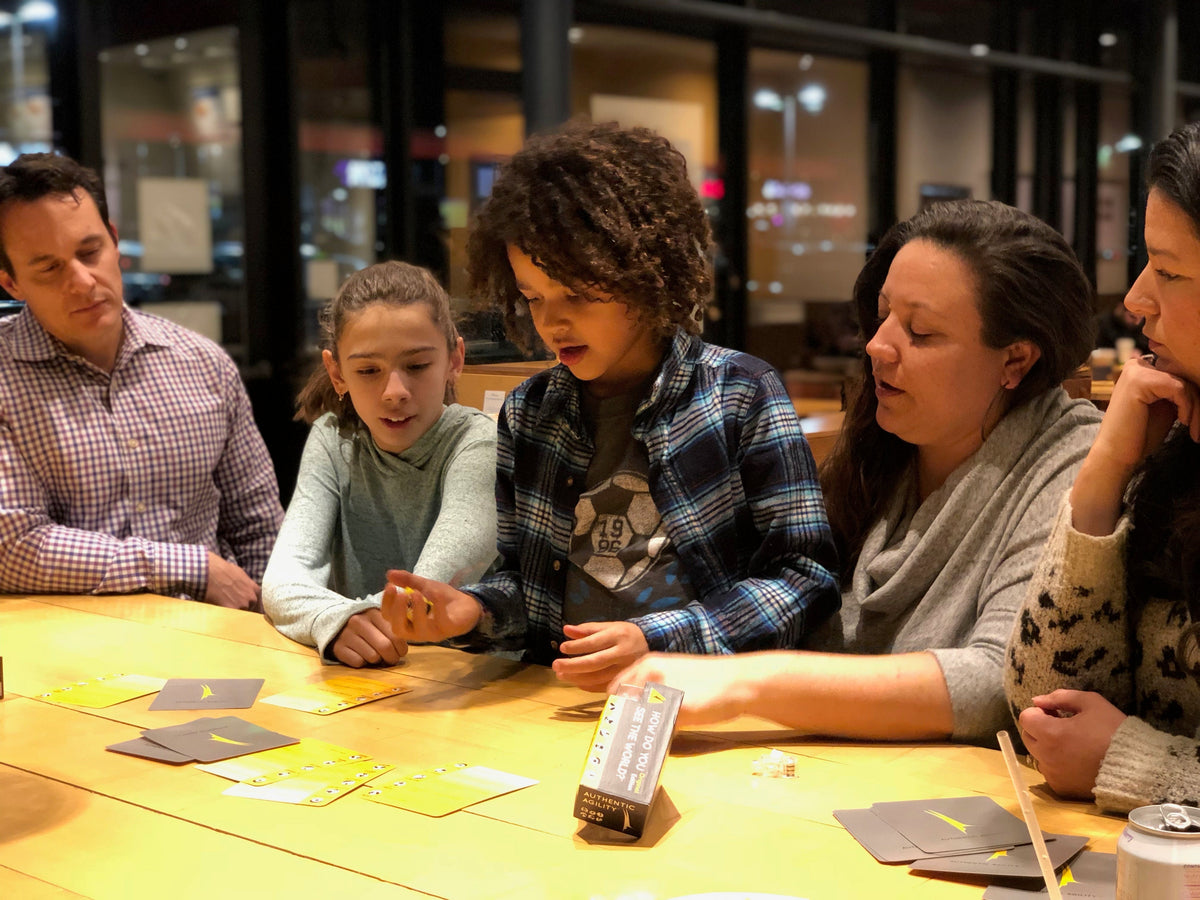
This is where structure helps more than spontaneity. Coming up with a great, specific, unexpected question on the spot, every night, after a full day—is a lot to ask of anyone. It’s a lot easier when the question is already sitting there, written on a card, so nobody has to invent it in real time. That’s not a failure of creativity. It’s just a reasonable amount of help.
It also removes a subtle bit of pressure: when a question comes from a card deck instead of a parent, it stops feeling like an interrogation and starts feeling like a game. Teenagers in particular tend to open up faster to a prompt that isn’t obviously “Mom trying to get me to talk.”
A Few Ground Rules That Make Any Question Work Better
Beyond swapping the question itself, a few small habits change how much you get back:
-
Ask once, then wait. Don’t fill the silence—the pause after a good question is often where the real answer shows up.
-
Answer it yourself too. Reciprocity matters. Sharing your own answer first (or right after) signals that this is a two-way moment, not a checkup.
-
Let “I don’t know” be a real answer sometimes. Not every question lands every night. That’s fine—the goal is a better average, not a perfect streak.
-
Keep it short. One good question beats five mediocre follow-ups. Resist the urge to turn it into a full debrief.
None of this requires a special occasion or a long, uninterrupted evening. It fits into the fifteen minutes you already have at the dinner table.
Where This Leads
Once you get the hang of asking better, more specific questions, you may notice something: the conversation starts extending itself. One good question tends to produce a follow-up question naturally, without you having to plan for it. That’s really the whole goal—not a perfect script, just a small shift that opens the door a little wider than “fine” allows.
If you’d rather not have to come up with a new question every night, that’s exactly what our thoughtful card games are built for—a stack of prompts designed to do what “how was your day” can’t, so your family dinner can go a little deeper without any extra effort on your part.
